From Managing Standards to Managing Performance: A Process-Centric IMS for Manufacturing
by Ann Gonzalez
Performance-Driven, Process-Centric Integrated Management System, Organizational Excellence
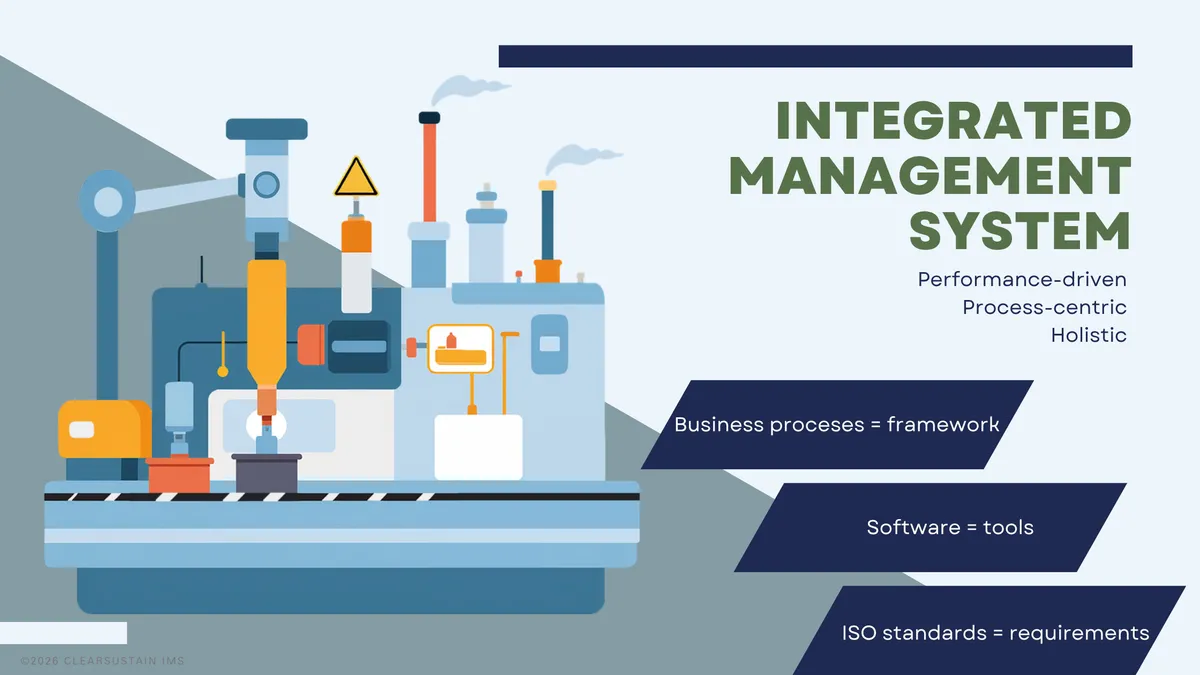
When people hear “management systems", they often think of software or ISO standards. Both are important elements of a management system, but neither should be the framework for how you run your business.
A management system should be the way an organization brings together its purpose, people, processes, and performance to achieve its business objectives.
ISO standards provide requirements to embed into the processes.
Software provides tools to support the processes.
Your business processes provide the framework.
For a manufacturing business, the goal isn't simply operational excellence or functional excellence within individual functions. Business performance depends on how those functions work together across the entire value chain. An effective management system connects functions, processes, people, risks, requirements and performance so the organization can operate as one interconnected system.

Driving Performance Through Process-Centric Integrated Management System
ISO defines management system as the way an organization manages the interrelated parts of its business to achieve its objectives. Those objectives can relate to product or service quality, operational efficiency, environmental performance, health and safety, and many other areas. ISO standards define requirements that a management system needs to address, but they do not prescribe how an organization must operate.
This distinction creates an important opportunity.
If the management system is structured primarily around ISO clauses, the organization can begin to manage standards rather than performance. Management system activities can become “check-the-box” tasks that are easy to audit but difficult for employees to connect to the work they perform every day.
A process-centric approach asks: What does the business need to accomplish, and what processes are required to achieve those results?
Clause Centric Framework | Process-Centric Framework |
Built around standard clauses and audit checklists. | Built around strategic and business performance goals. |
Requirements drive the structure | Business objectives and processes drive the structure |
Employees think in terms of “the QMS,” “the EMS,” or “the safety system” | Employees see an integrated way of functioning and operating |
Can reinforce functional or departmental silos | Connects functions across the value chain |
Focuses primarily on compliance | Focuses on performance while meeting requirements |
KPIs may be added to satisfy requirements | Performance measures drive how processes are managed |
Certification and Audits can become the primary reference point | Business performance is the primary reference point |
Audits focus heavily on whether requirements are addressed | Audits evaluate whether processes are effective to deliver expected performance and meeting requirements |
If each standard becomes a separate management-system structure, the organization can end up creating multiple perspectives of the same work. ISO has intentionally developed a common structure for management-system standards to make integration easier. But integration should not stop at integrating the standards. The deeper opportunity is to integrate the requirements and applicable best practices into the business processes—the way your manufacturing business actually operates. The system stops being something designed primarily “for the auditor” and becomes how we run the business.
Expand from Operational Excellence to Organizational Excellence
With an integrated management system as the foundation, four connected elements guide daily decisions, resource allocation, and improvement priorities:
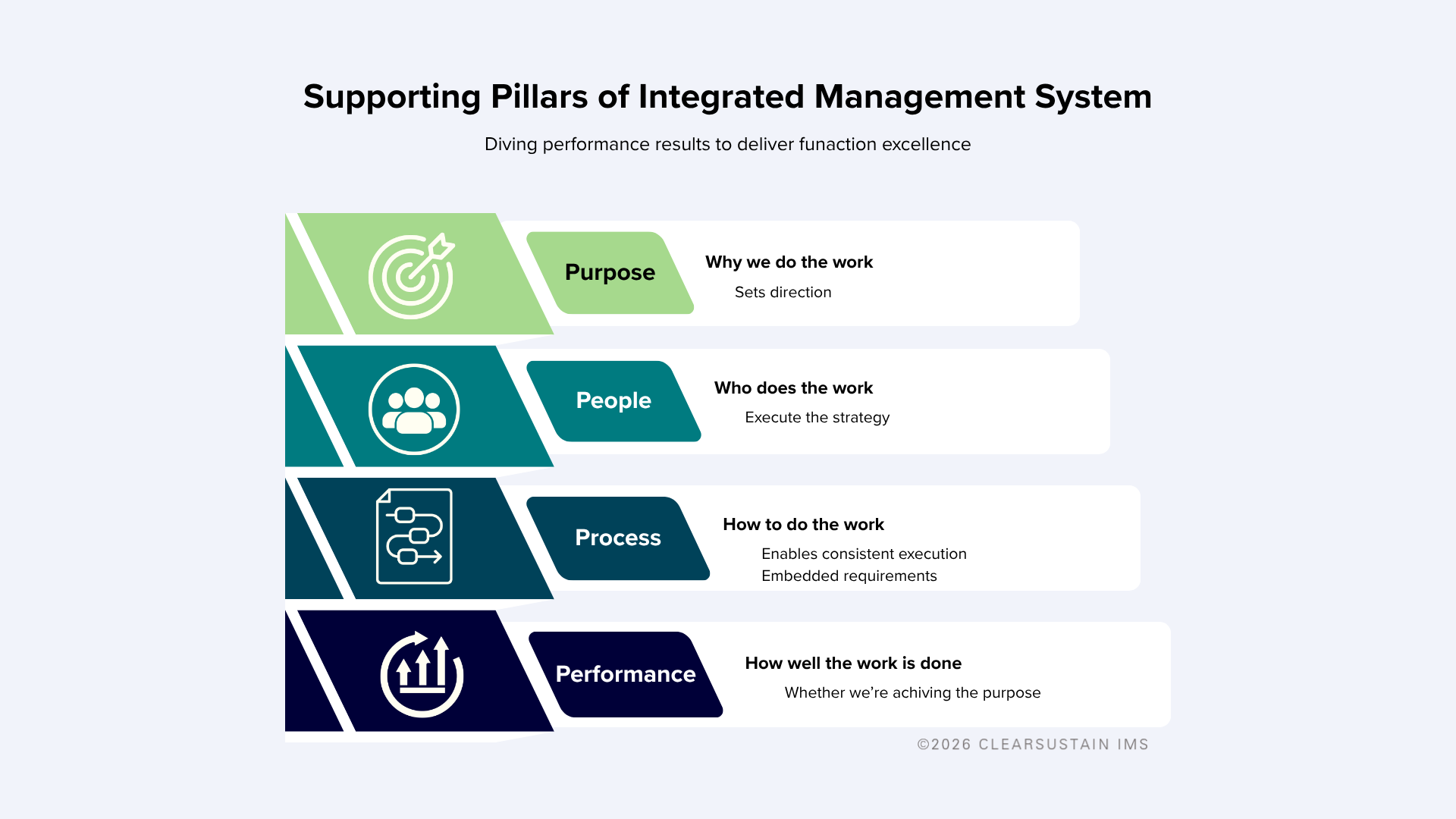
Purpose
Why does your business exist? Who does it serve, and what value does it deliver?
A clear purpose establishes what the organization is trying to achieve and helps determine which business performance measures matter most.
People
Who does the work, and how do they contribute to achieving the organization's objectives?
Leaders and employees need clear accountabilities, appropriate resources, and an understanding of how their work contributes to business results.
A good management system gives people line of sight from their daily work to organizational performance.
Process
How is work actually done?
Business processes should be designed around the intended results the organization needs to achieve. Requirements, risks, controls, resources, and responsibilities should be built into the process rather than managed as separate activities.
Processes and procedures should help people perform their work consistently while meeting quality, health and safety, environmental, regulatory, and customer requirements.
Performance
How well are we achieving our intended results, and what needs to improve?
Performance measures should show whether processes are producing the expected results. Performance reviews, internal audits, management meetings, and improvement activities should work together to identify trends, address problems, and prioritize improvement where it matters most.
When these four elements are aligned, the management system becomes more than a collection of procedures and records. It becomes a performance engine that helps the organization make better decisions, manage risk, improve processes, and achieve its objectives. Beyond Operations, each business function has greater clarity about what it needs to achieve, how its work contributes to organizational objectives, and how its performance affects other functions across the value chain.
This alignment enables functional excellence—strong performance within sales, engineering, procurement, operations, quality, maintenance, EHS, finance, customer service, and other functions. Each function must perform effectively, and the functions must also work together toward the same intended result.
The customer doesn't experience individual functions independently. The customer experiences the result of the organization working together as an interconnected system. Therefore, the goal of an IMS is to create the alignment that enables functional excellence to work together across the organization—resulting in organizational excellence and stronger business performance.
Practical Steps to Make Your Management System Work for You
Whether you are building a formal management system for the first time or redesigning systems you already have, start with the business—not the standards.
Identify the intended results that create value and map key processes that deliver them.
What results define successful performance for your manufacturing business? Consider a balanced set of measures across areas such as:
Quality
Productivity
Cost and profitability
Health and safety
Environmental performance
Business growth
Then identify the core processes that most strongly influence each intended result.
For example:
Customer value: Conforming product delivered when promised
Intended result: product consistently meets specifications
Key Processes: Operations Planning, Procurement, Operations Control, and Inspections.
Incorporate requirements and expectations into the processes.
Build quality, health and safety, environmental, regulatory, customer, and other applicable requirements directly into the way work is performed. Design processes and procedures with the people who use them. Then test whether they actually support effective performance in practice. The goal is for employees to do the work correctly—not to manage separate management systems while doing the work. This reduces duplication and improves both compliance and efficiency.
Monitor, Review, and improve.
Establish regular performance reviews where leaders and process owners evaluate results against objectives, identify trends, and prioritize improvement. Use internal audits to determine whether processes are effectively implemented, achieving their intended results, and meeting applicable requirements. When a process is not producing the expected result, don't simply correct the immediate problem. Look at the process and the interactions around it to understand what needs to change.
A management system should not exist alongside the business. It should be how the business manages itself. ISO standards can provide valuable requirements and guidance. Software can provide valuable tools. But neither should dictate the architecture of how your organization operates. The opportunity is to build an Integrated Management System around your business processes, then embed the applicable requirements, risks, controls, and performance measures into those processes.
When purpose, people, processes, and performance are aligned, the management system can become a foundation for:
Better processes
Better decisions
Lower risk
Less waste
Stronger compliance
Better business performance
Design or Redesign Your Management System with Process-Centric IMS Framework
If your current management systems feel like a burden—or if you're starting from scratch—the Process-Centric IMS Framework can help. ClearSustain IMS created a simple, customizable framework designed to help manufacturing organizations address multiple ISO standards without unnecessary duplication while keeping the focus on operational efficiency, risk management, compliance, and sustainable business performance.
Watch the Free On-Demand Webinar: The Business Value of an Integrated Management System to learn how an integrated approach can transform your management system from a compliance obligation into a business-performance tool.
Reference:
