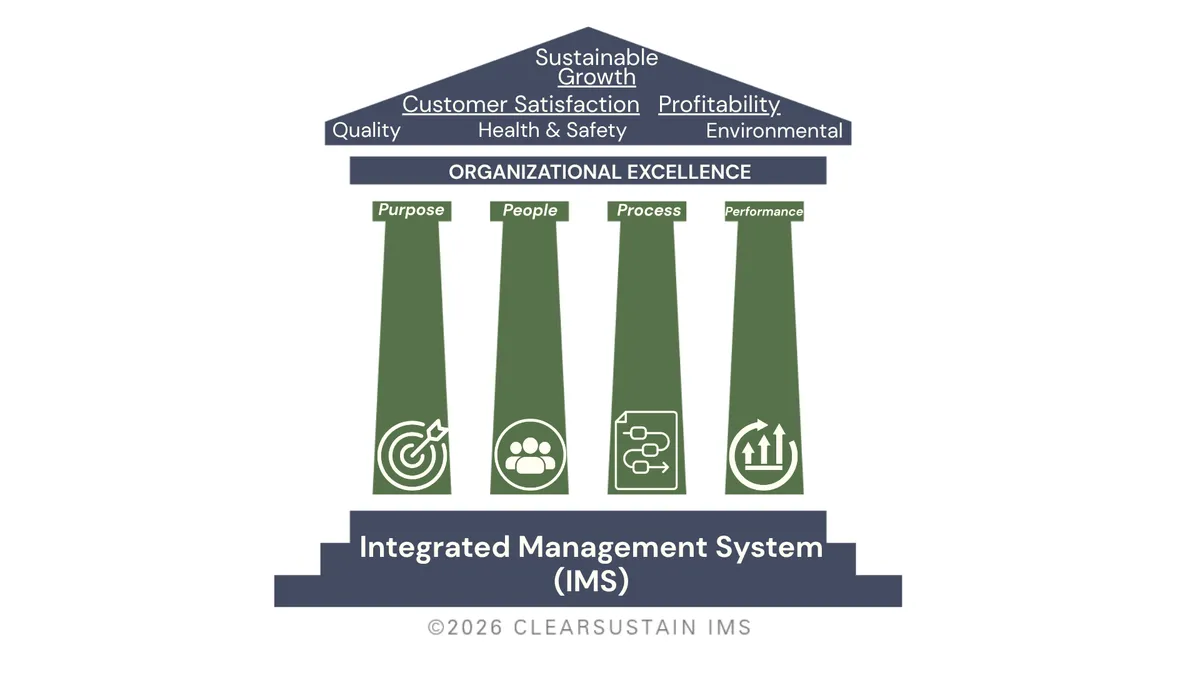
Organizational Excellence through a Performance-Driven, Process-Centric Integrated Management System
by Ann Gonzalez
Performance-Driven, Process-Centric Integrated Management System, Organizational Excellence
What Does It Mean for a Manufacturing Business to Excel?
What does it mean for a manufacturing business to excel? Effective processes, high-performing departments, efficient operations, disciplined continual improvement, and consistently strong business results can all contribute to excellence, but none operates in isolation.
In practice, organizations often pursue these objectives separately, even though they are interconnected. A manufacturing organization can have highly capable departments while processes break down at functional boundaries. It can improve individual processes while creating unintended consequences elsewhere. It can also pursue continual improvement without a clear connection to organizational priorities. These situations demonstrate an important point: excellence in one part of the organization does not automatically create excellence across the organization.
For manufacturing leaders, the challenge is not simply to improve individual parts of the business. It is to create an organization in which those parts work together to achieve shared outcomes. A performance-driven, process-centric Integrated Management System (IMS) provides a framework for doing that. It connects how the organization operates with how it manages performance and improvement, providing a foundation for organizational excellence.
Excellence Cannot Be Viewed in Isolation
Terms such as Process Excellence, Functional Excellence, Operational Excellence, and Organizational Excellence describe different dimensions of how an organization performs. They are related, but they operate at different scopes.
Process Excellence is the systematic improvement of processes to effectively and efficiently achieve intended outcomes with appropriate consistency, control, and adaptability. Functional Excellence focuses on the capability of an organizational function to effectively perform its responsibilities and contribute to organizational objectives. Operational Excellence is a disciplined approach to effective execution, performance management, problem solving, and continual improvement across organizational processes and operations. Organizational Excellence considers whether the entire organization functions as an integrated and aligned system.
These dimensions are not separate stages that an organization completes one after another. They interact. A process depends on capable functions; functions contribute to processes; processes cross organizational boundaries; and continual improvement depends on performance information and the organization's ability to act on it.
This is why improving one dimension in isolation can have limited impact. The organization needs a way to connect these dimensions around a common purpose and shared outcomes.
The Integrated Model
Some established models represent Process Excellence, Operational Excellence (OpEx), and Organizational Excellence as three concentric circles. For a manufacturing organization, this concept can be extended to show how the different dimensions interact within an integrated management framework.
The model places Process Excellence at the center, where the flow of work is improved. Operational Excellence expands the focus to execution and continual improvement, while Organizational Excellence encompasses the organization as an integrated system.
Two dimensions cut across these scopes. Functional Excellence represents the capabilities within functions, while Value-Chain Alignment connects those functions horizontally around shared end-to-end outcomes. The IMS provides the foundation, connecting purpose, people, processes, and performance. Business Performance represents the resulting business outcomes.
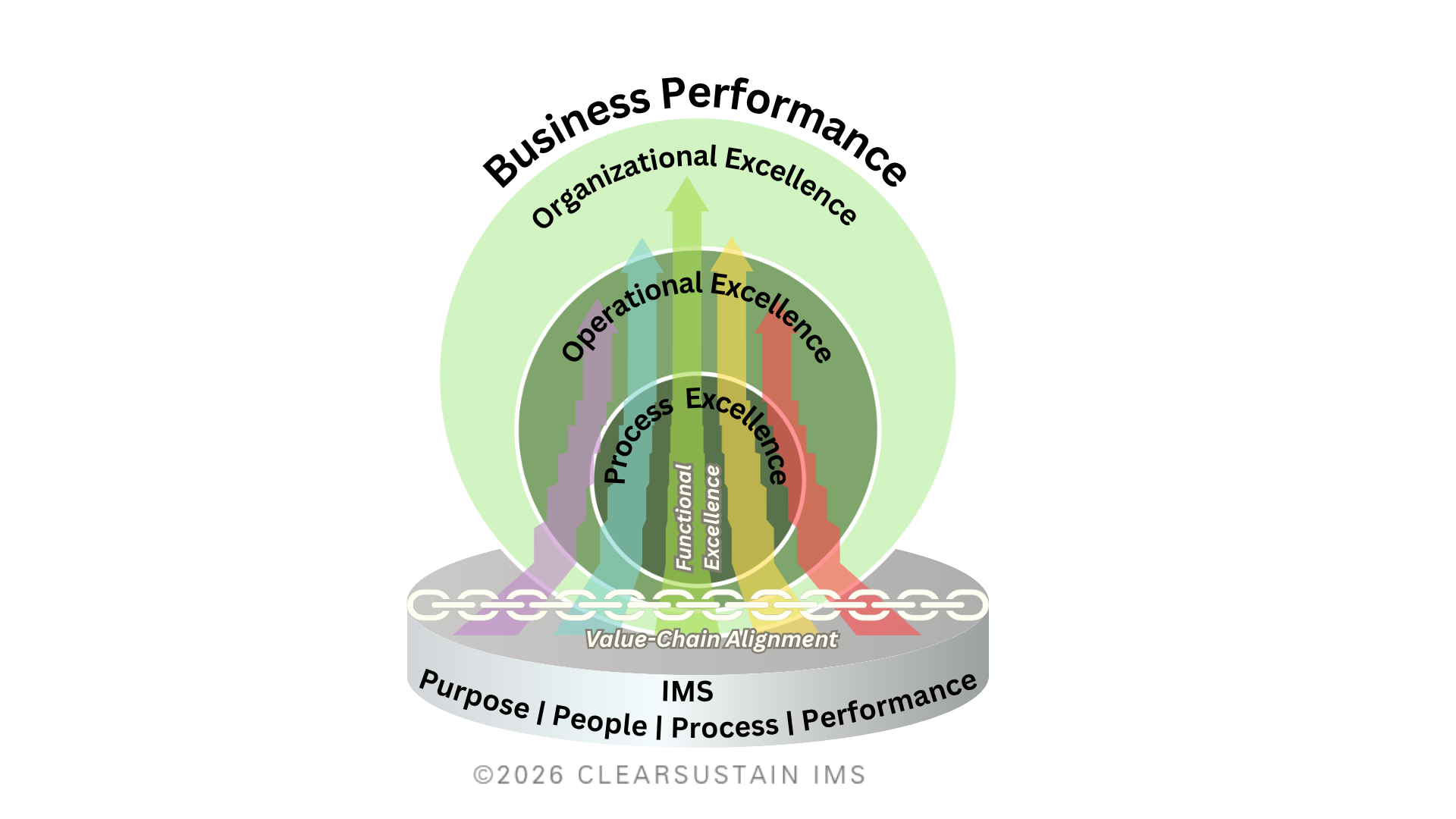
The relationship can be summarized as:
The IMS provides the foundation.
Process Excellence improves the flow of work.
Functional Excellence strengthens organizational capabilities.
Value-Chain Alignment connects functions around shared outcomes.
Operational Excellence drives disciplined continual improvement.
Organizational Excellence integrates the organization as one system.
Business Performance reflects sustained business results.
How the Dimensions Work Together
The IMS provides the management architecture that allows these dimensions to operate as part of one system rather than as separate initiatives.
Process Excellence improves process flow, interfaces, effectiveness, efficiency, and control. Functional Excellence strengthens capabilities within departments and functions. Value-Chain Alignment connects those functions around shared outcomes rather than isolated departmental objectives.
Operational Excellence brings execution, performance management, problem solving, and continual improvement together. It provides the discipline for turning performance information into action and improvement across processes and functions.
When these dimensions work together, the organization can move beyond excellence within individual processes or functions toward Organizational Excellence—the ability to operate as an integrated system in pursuit of its purpose and desired results.
The IMS does not create excellence by itself. It provides the management foundation through which the different dimensions can be aligned, managed, and improved as a system.
What This Means for the Business
For a manufacturing organization, the value of this approach is not in adopting another set of management terminology. It is in creating a coherent way to see how the parts of the business contribute to the whole.
A performance-driven, process-centric IMS can provide the structure for connecting functional capability, end-to-end processes, organizational priorities, performance information, risks, and continual improvement. The result is a management system designed around how the business operates and the results it needs to achieve.
The goal is not excellence in isolated parts of the organization. It is an organization in which purpose, people, processes, and performance work together to create sustained business value.
The ultimate measure is simple:
Does the management system help the business perform?
See How an Integrated Management System Can Create Business Value
Explore how a performance-driven, process-centric approach can connect your management system to business performance and organizational excellence.
Watch the Free On-Demand Webinar: The Business Value of an Integrated Management System
Reference:
The Blueprint for Organizational Excellence - Leadership Circle®
Process, Operational, & Business Excellence: Key Differences
What is Organizational Excellence? Organizational Excellence Model | ASQ
